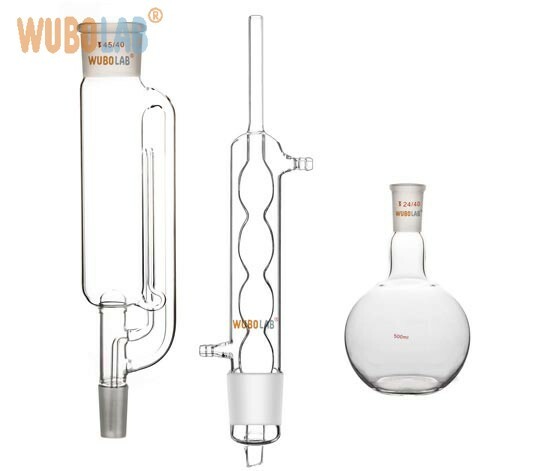
Each assembly comprises the basic components for solid-liquid extraction: Flask/Soxhlet extractor/Condenser/Associated lids and clips
Color: Clear
Material: Boro 3.3
Usage: Lab Experiment
Feature: Thick Wall
Packing: Safe Exported Cartons
Product Code
Flask volume (ml)
Extraction tube Diam.(mm)
Extraction Tube Length (mm)
Siphon length (mm)
Spherical condenser length(mm)
E10046033
60ml
33
150
60
200
E10041003
100ml
33
160
70
210
E10041503
150ml
33
170
80
220
E10042503
250ml
40
190
90
240
E10045005
500ml
50
230
110
270
E10041000
1000ml
55
250
150
300
E10042000
2000ml
100
300
200
400
Color: Clear
Material: Boro 3.3
Usage: Lab Experiment
Feature: Thick Wall Packing:
Safe Exported Cartons
A Soxhlet extractor is a piece of laboratory apparatus invented in 1879 by Franz von Soxhlet. It was originally designed for the extraction of a lipid from a solid material.
Typically, Soxhlet extraction is used when the desired compound has a limited solubility in a solvent, and the impurity is insoluble in that solvent.
It allows for unmonitored and unmanaged operation while efficiently recycling a small amount of solvent to dissolve a larger amount of material.
The Soxhlet Extraction Apparatus is used in the extraction of lipids and other materials from a solid sample when the desired compound has a limited solubility in a solvent.
Applications include the production of tinctures, aromatic alcohols, and other products of botanical extraction; food testing; biofuels; and environmental analysis of soils, sludge, and wastes.
Assembled from 3 separate sections: a boiling flask, extractor chamber, and condenser. Interchangeable standard joints.